
People in Public and Community Services work hard for their families and communities. Some give their all as care and support workers, librarians, hospital interpreters and social workers. But for far too long, work that has largely been done by women has been undervalued and underpaid by employers, governments, and funders. That legacy and those decisions have left far too many women struggling
to make ends meet on low wages, improperly remunerated for what they do, and weakened core services all of us rely on.
One of the most effective levers to ensure people of all genders are paid fairly are pay equity claims enabled by the Equal Pay Act. These settlements are life changing for people who are most often the ones doing the important, difficult work of strengthening communities and caring for people.
For example, this year 5,000 social workers based in iwi and community services won pay equity, with the average person covered receiving a 27% pay increase. For community-based social worker and PSA member
Stephanie Brown, pay equity would, “transform our sector and the lives of social workers”.
A rigorous process
Pay equity claims follow a rigorous process overseen by Te Kawa Mataaho the Public Service Commission to establish how much people's work has been undervalued due to gender-based pay discrimination, then rectify that injustice by establishing pay rates that reflect the genuine value of the work.
First, unions raise a claim against employers and establish that its arguable. Interviews are conducted with workers to produce a job profile – a description of what people covered by the claim do at work, including the levels of skill, responsibility, experience, and effort required of them. That profile is analysed against job profiles of comparable work that has mostly been done by men, like fisheries officers, customs officers, or health and safety inspectors. Unions and employers enter bargaining to agree on pay equity rates, terms, and conditions. Finally, people covered by the claim are offered a settlement that they vote to accept or reject.
Some successes...
Roughly 16,000 Allied health workers across 120 professions including social workers, hospital dental assistants, and sterile sciences technicians will receive an average 20% pay rise after five years of organising to achieve their claim.
Nurses voted to accept their claim in July, settling a joint claim by the New Zealand Nurses Organisation (NZNO) and the PSA that included a staunch struggle to secure adequate backpay for the new rates. Librarians and interpreters working for Te Whatu Ora (Health New Zealand) voted to accept their settlement in November (read more about these success stories).
These are significant steps toward equity that have been hard-won. Like most disruptions to the status-quo, pay equity claims receive pushback – often in the form of bureaucratic delays and attempts to undermine the process. Despite the evidence-based framework, members often must organise, lobby, and rally to ensure their settlement goes through.
But there's a lot more to do...
While these are significant steps, several pay equity claims are yet to be resolved. 65,000 care and support workers go to work each day on undervalued rates because of interference in their claim by funding agencies like Te Whatu Ora, leading to massive delays to their claim. The PSA, E tū, and NZNO have spent more than a year rigorously proving and measuring the undervaluation of care and support workers, with each milestone receiving the requisite sign-off.
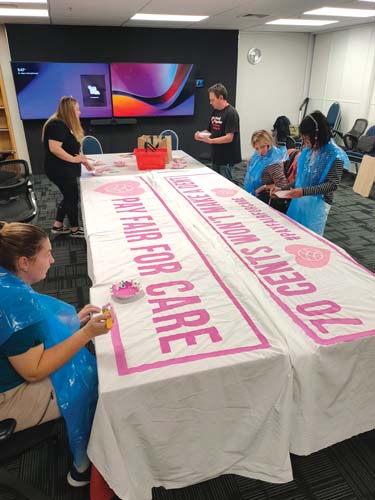
But in the final stages, a surprise, unnecessary review was sprung on them to undermine the process. The situation is now urgent; the Care and Support Workers Pay Equity Settlement Act is due to expire on 31 December with no assurance of how its protections will be maintained. Unions are working hard to progress the claim in spite of the review to ensure people are paid what they’re worth.
The PSA has recently brought the claims for library assistants in local government and admin and clerical workers in the public service to the point where assessments of their work, and the work comparable roles in male-dominated industries has been completed.
Get involved
The PSA has been organising hard for pay equity since our beginning. We will not stop until work done by women is paid justly. We’re calling on all members to take opportunities to be in solidarity with your fellow members and take action to support their pay equity claims in the coming months.

